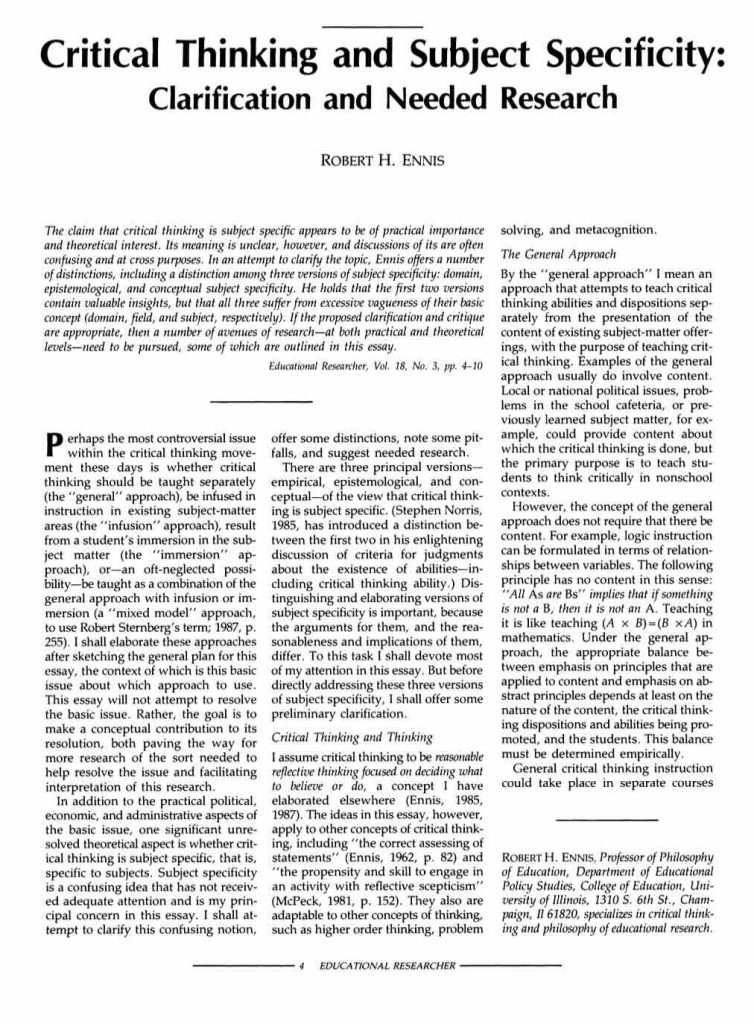
Topic: This paper “Critical Thinking and Subject Specificity: Clarification and Needed Research” aims to develop the mechanics for understanding how critical thinking may be subject specific, including distinguishing domain, epistemological and conceptual subject specificity.
Author: Robert H. Ennis
Abstract: The claim that critical thinking is subject specific appears to be of practical importance and theoretical interest. Its meaning is unclear, however, and discussions of its are often confusing and at cross purposes. In an attempt to clarify the topic, Ennis offers a number of distinctions, including a distinction among three versions of subject specificity: domain, epistemological, and conceptual subject specificity. He holds that the first two versions contain valuable insights, but that all three suffer from excessive vagueness of their basic concept (domain, field, and subject, respectively). If the proposed clarification and critique are appropriate, then a number of avenues of research-at both practical and theoretical levels-need to be pursued, some of which are outlined in this essay.
Reference: R.H. Ennis (1989) Critical Thinking and Subject Specificity: Clarification and Needed Research. Educational Researcher. 18(3): 4-10- https://doi.org/10.3102/0013189X018003004
See paper: https://criticalthinking.net/wp-content/uploads/2024/04/Ennis-CriticalThinkingSubject-1989.pdf
This paper can be accessed at https://journals.sagepub.com/doi/10.3102/0013189X018003004#core-collateral-purchase-access. This paper has 2328 citations according to Google Scholar (July, 2026).